A MAN CALLED PETER
by Catherine Marshall · McGraw-Hill
An instant bestseller in 1951, this is the compelling story of Peter Marshall, the Scottish immigrant who became chaplain of the U.S. Senate.


by Catherine Marshall · McGraw-Hill
An instant bestseller in 1951, this is the compelling story of Peter Marshall, the Scottish immigrant who became chaplain of the U.S. Senate.



by Whittaker Chambers · Random House
Whittaker Chambers has written one of the really significant American autobiographies...penetrating and terrible insights into America in the early twentieth century. --Arthur Schlesinger, Jr.

by Anne Frank · Doubleday
Biografie van een jong meisje uit de oorlogsjaren.

by Consuelo Vanderbilt Balsan · Harper and Brothers
The life story of the American heiress and Duchess of Marlborough, whose experiences inspired the character of Downtown Abby's Lady Grantham, describes her arranged marriage, her observations of the intricate hierarchy of her home in Blenheim Palace, and her encounters with famous historical figures.
by Elizabeth Gray Vining · J. B. Lippincott Company
The record of the author's four years at the Imperial Court, where she helped to teach and guide the young Prince from a chubby child to a poised, attractive youth with a high sense of responsibility.


by H.A. Overstreet · W.W. Norton and Company
This work has been selected by scholars as being culturally important, and is part of the knowledge base of civilization as we know it. This work was reproduced from the original artifact, and remains as true to the original work as possible. Therefore, you will see the original copyright references, library stamps (as most of these works have been housed in our most important libraries around the world), and other notations in the work. This work is in the public domain in the United States of America, and possibly other nations. Within the United States, you may freely copy and distribute this work, as no entity (individual or corporate) has a copyright on the body of the work. As a reproduction of a historical artifact, this work may contain missing or blurred pages, poor pictures, errant marks, etc. Scholars believe, and we concur, that this work is important enough to be preserved, reproduced, and made generally available to the public. We appreciate your support of the preservation process, and thank you for being an important part of keeping this knowledge alive and relevant.


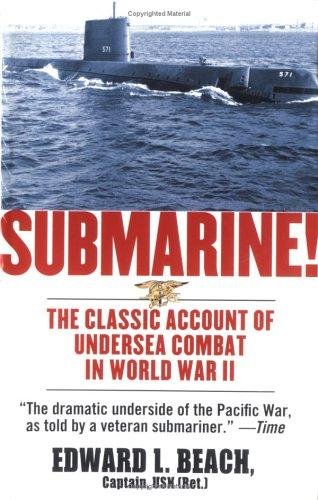
by Edward L. Beach · Henry Holt and Company
Welcomed as the first book about American submarines in World War II to be written by a man who actually fought in them, this compelling personal account of the war beneath the sea firmly established Edward L. Beach's reputation as a writer in the early 1950s. Given the survival rate of those in the silent service, it is a story many submariners did not live to tell. In fact, most of the crew of Beach's boat, the USS Trigger, were lost soon after he left for another assignment. A veteran of twelve war patrols, Beach authentically recaptures the moments of elation, desperation, and numbing fear that were part of the daily lives of these warriors as they hunted down the enemy in the Pacific. Beach helped sink the Trigger's first ships and survived more than his share of exploding depth charges from avenging warships. This book weaves the Trigger's story with the equally thrilling tales of other battle-hardened submarines and the brave men who fought in them against the Japanese. Readers share in the destruction of five destroyers in four days and join in the deadliest game of all -- stalking other submarines. They also come to understand the terror and uncertainty of being at the other end of the pursuit, and silently sweating out depth-charge poundings in a leaking boat. For an authentic account of what went on under the waves, this book remains one of the very best. Book jacket.

by William L. Shirer · Farrar, Straus and Young
In his "Midcentury Journey" William L. Shirer revisits and re-appraises the chief cities and countries of western Europe which he covered as a newspaper and radio correspondent from 1925 to 1940. He found more vitality in shattered Vienna than in unscathed Paris, while the Germans seemed unregenerate and perhaps more dangerous than the Russians. The war sent all western Europe, including Britain, into a decline. Although we Americans came out of the war stronger than we went in, the present anti-Communist hysteria shows us suffering from the same symptoms that discourage or enrage us in others. Over the past quarter century, William Shirer added greatly to our understanding of western Europe, and in this volume, he has interpreted certain historical events that he witnessed in such a way as to make the reader reassess these events.

Historical bestseller data sourced from the New York Times Book Review, archived by Hawes Publications.