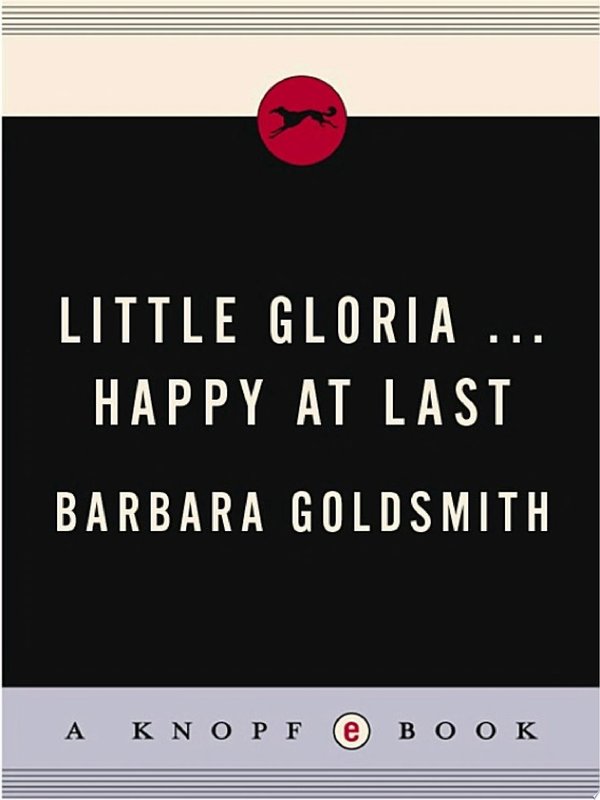
LITTLE GLORIA ... HAPPY AT LAST
by Barbara Goldsmith · Knopf
11 wks on list
This is a story of money, glamour, and scandal (on the highest level); a story of American society and of European royalty; a story of family strife exploding into one of the most dramatic and publicized court battles of the century—the battle for a solemn ten-year-old child, “little Gloria” Vanderbilt, who in 1934 was the object of the epic custody suit between her mother, the beautiful and penniless Vanderbilt widow, and her aunt, the famous Gertrude Vanderbilt Whitney, whose $78 million could buy her anything she wanted. And what she wanted was “little Gloria.” The leading characters: Gloria Morgan, who was one of the fabled Morgan Twins (invented by society reporter “Cholly” Knickerbocker as the quintessential Café Society beauties) and who, as a shy, stammering eighteen-year-old, living on nothing a year, did what she was raised to do, becoming the wife of . . . Reggie Vanderbilt, at forty-three a worn-out alcoholic who had managed to go through almost $25 million in fourteen years and who died only two years after his marriage to Gloria, leaving his beautiful young widow nothing but their baby, their baby’s untouchable trust fund, and the Vanderbilt name . . . Gloria Morgan’s twin, Thelma, who, as Lady Furness, was for years the mistress of the Prince of Wales (until she introduced him to her “best friend” Wallis Simpson) . . . Gertrude Vanderbilt Whitney, Reginald’s sister, a formidable Society woman, a sculptor and the founder of the Whitney Museum of American Art, a woman who conformed—on the surface—to everything expected of American royalty and yet lived a hidden second life as a passionate bohemian . . . And the child—little Gloria herself—shunted out of her mother’s life, carted around Europe, depending for her existence on her neurotically overprotective nurse, Dodo, who never left her for a single day, and her mad Morgan grandmother, who insisted that her own daughter might murder the child for the Vanderbilt millions. Deserted, “dressed in rags,” neglected, she became an almost mythic incarnation of “the poor little rich girl.” This child, who was to grow up to become a world-famous fashion designer, her name—Gloria Vanderbilt—a household word. We come to understand and care about this child as we observe, close up, the astonishing lives and intrigues surrounding her. We see her at the age of ten brought to the courthouse, rushed through mobs of spectators, reporters, photographers. We follow a courtroom drama of sensation after sensation, the judge ultimately banning both public and press, the final scandalous testimony reaching to the heart of the English royal family. We listen to the parade of witnesses—servants, millionaires, society celebrities, aristocrats, family retainers. We watch the judge himself—a classic Tammany pol—becoming another of the many victims of the case, reviled on all sides. And finally we see little Gloria pushed to choose between her mother and her aunt, making the decision that will affect her whole life—with nobody ever asking her the basic question, “Why are you afraid?” For the first time, the thousands of pages of documents and sealed court testimony have been unearthed and explored. Hundreds of people have been interviewed. And a writer completely knowing about society and the period has used all this material to create a compelling narrative of vitality, resonance, and fascination. Combining her extraordinary abilities as an investigative reporter with the skills and sensitivity of a novelist, Barbara Goldsmith has given us a galvanizing story, a whole world of astonishing emotional and social circumstances, unforgettably revealed.