
1
—
JOHN ADAMS
David McCullough

JOHN ADAMS
by David McCullough · Simon & Schuster
14 wks at #1 · 9 on list
Profiles John Adams, an influential patriot during the American Revolution who became the nation's first vice president and second president.
by David McCullough · Simon & Schuster
Profiles John Adams, an influential patriot during the American Revolution who became the nation's first vice president and second president.

by Malika Oufkir and Michèle Fitoussi · Talk Miramax/Hyperion
Twenty years in a desert jail.

by Dominick Dunne · Crown
This is the story of the Trial of the Century as only Dominick Dunne can write it. Told from the point of view of one of Dunne's most familiar fictional characters-Gus Bailey-Another City, Not My Own tells how Gus, the movers and shakers of Los Angeles, and the city itself are drawn into the vortex of the O.J. Simpson trial. We have met Gus Bailey in previous novels by Dominick Dunne. He is a writer and journalist, father of a murdered child, and chronicler of justice-served or denied-as it relates to the rich and famous. Now back in Los Angeles, a city that once adored him and later shunned him, Gus is caught up in what soon becomes a national obsession. Using real names and places, Dunne interweaves the story of the trial with the personal trials Gus endures as he faces his own mortality. By day, Gus is at the courthouse, the confidant of the Goldman and Simpson families, the lawyers, the journalists, the hangers-on, even the judge; at night he is the honored guest at the most dazzling gatherings in town as everyone-from Kirk Douglas to Heidi Fleiss, from Elizabeth Taylor to Nancy Reagan-delights in the latest news from the corridors of the courthouse. Another City, Not My Own does what no other book on this sensational case has been able to do because of Dominick Dunne's unique ability to probe the sensibilities of participants and observers. This book illuminates the meaning of guilt and innocence in America today. A vivid, revealing achievement, Another City, Not My Own is Dominick Dunne at his best.
by Joseph J. Ellis · Knopf
An illuminating study of the intertwined lives of the founders of the American republic--John Adams, Aaron Burr, Benjamin Franklin, Alexander Hamilton, Thomas Jefferson, James Madison, and George Washington. During the 1790s, which Ellis calls the most decisive decade in our nation's history, the greatest statesmen of their generation--and perhaps any--came together to define the new republic and direct its course for the coming centuries. Ellis focuses on six discrete moments that exemplify the most crucial issues facing the fragile new nation: Burr and Hamilton's deadly duel, and what may have really happened; Hamilton, Jefferson, and Madison's secret dinner, during which the seat of the permanent capital was determined in exchange for passage of Hamilton's financial plan; Franklin's petition to end the "peculiar institution" of slavery--his last public act--and Madison's efforts to quash it; Washington's precedent-setting Farewell Address, announcing his retirement from public office and offering his country some final advice; Adams's difficult term as Washington's successor and his alleged scheme to pass the presidency on to his son; and finally, Adams and Jefferson's renewed correspondence at the end of their lives, in which they compared their different views of the Revolution and its legacy. In a lively and engaging narrative, Ellis recounts the sometimes collaborative, sometimes archly antagonistic interactions between these men, and shows us the private characters behind the public personas: Adams, the ever-combative iconoclast, whose closest political collaborator was his wife, Abigail; Burr, crafty, smooth, and one of the most despised public figures of his time; Hamilton, whose audacious manner and deep economic savvy masked his humble origins; Jefferson, renowned for his eloquence, but so reclusive and taciturn that he rarely spoke more than a few sentences in public; Madison, small, sickly, and paralyzingly shy, yet one of the most effective debaters of his generation; and the stiffly formal Washington, the ultimate realist, larger-than-life, and America's only truly indispensable figure. Ellis argues that the checks and balances that permitted the infant American republic to endure were not primarily legal, constitutional, or institutional, but intensely personal, rooted in the dynamic interaction of leaders with quite different visions and values. Revisiting the old-fashioned idea that character matters, Founding Brothers informs our understanding of American politics--then and now--and gives us a new perspective on the unpredictable forces that shape history.
by George Carlin · Hyperion
"The thinking person's comic offers a hilarious new collection of razor-sharp observations ..."--Page 4 of cover.
by Melissa Etheridge with Laura Morton · Villard
ln the ten years since she burst on to the international music scene, Melissa Etheridge has released six albums that have sold more than 25 million records worldwide, garnering not only public adoration for her uncompromising honesty but numerous critical awards, including two Grammys and the prestigious ASCAP Songwriter of the Year award. She has given the world unforgettable hits such as "Bring Me Some Water," "Similar Features," "Come to My Window," and "I'm the Only One," with lyrics that touch on a universal nerve and the deeply human side of relationships. Her personal journey has been captured over the years through her music, transforming her voice and musicianship into inspiring messages of love, consciousness, hope, longing, desire, and pure passion. The Truth Is ... is a bold and unflinching account of an extraordinary life, described as only Melissa can: from her Kansas roots through her early love of music to her brilliant rise to stardom, becoming a female superstar in a male-dominated rock world. Melissa will openly discuss the massive impact of her public coming-out, a revelation that only increased her popularity and made her a highly visible spokesperson for the gay and lesbian community. The Truth Is ... shares Melissa Etheridge's fascinating story—sometimes shocking, always inspiring—with unprecedented candor and insight. Filled with personal insights, the stories behind the music and lyrics, and never-before-seen personal photographs, The Truth Is ... is a poignant, thoughtful, sometimes difficult expression of who Melissa Etheridge has been, who she is, and who she hopes to become.

by Doug Stanton · Holt
A harrowing, adrenaline-charged account of America's worst naval disaster -- and of the heroism of the men who, against all odds, survived. On July 30, 1945, the USS Indianapolis was torpedoed in the South Pacific by a Japanese submarine. An estimated 300 men were killed upon impact; close to 900 sailors were cast into the Pacific Ocean, where they remained undetected by the navy for nearly four days and nights. Battered by a savage sea, they struggled to stay alive, fighting off sharks, hypothermia, and dementia. By the time rescue arrived, all but 317 men had died. The captain's subsequent court-martial left many questions unanswered: How did the navy fail to realize the Indianapolis was missing? Why was the cruiser traveling unescorted in enemy waters? And perhaps most amazing of all, how did these 317 men manage to survive? Interweaving the stories of three survivors -- the captain, the ship's doctor, and a young marine -- journalist Doug Stanton has brought this astonishing human drama to life in a narrative that is at once immediate and timeless. The definitive account of a little-known chapter in World War II history, In Harm's Way is destined to become a classic tale of war, survival, and extraordinary courage.
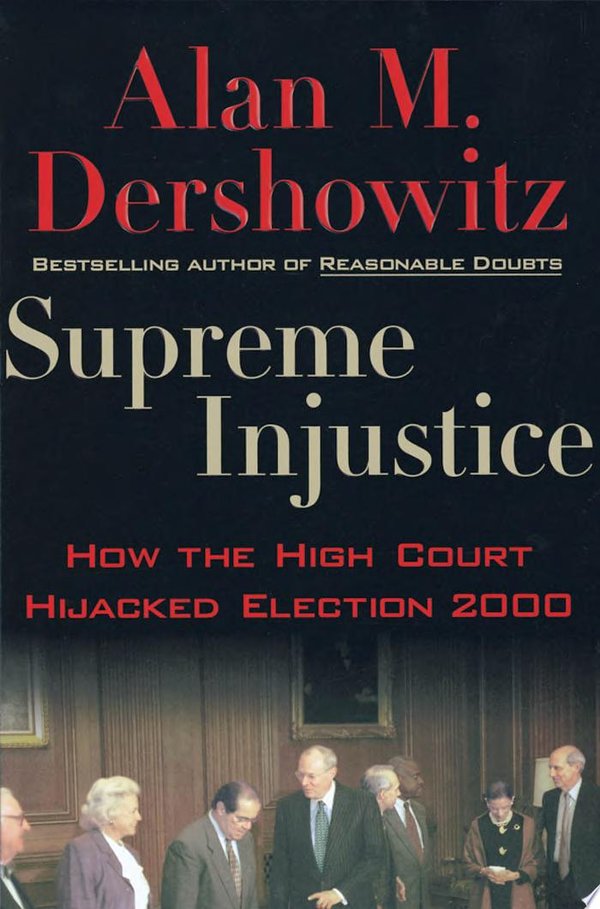
by Alan M. Dershowitz · Oxford University Press
Millions of Americans were baffled and outraged by the U.S. Supreme Court's role in deciding the presidential election of 2000 with its controversial ruling in Bush v. Gore. The Court had held a unique place in our system of checks and balances, seen as the embodiment of fairness and principle precisely because it was perceived to be above the political fray. How could it now issue a decision that reeked of partisan politics, and send to the White House a candidate who may have actually lost the election? In Supreme Injustice, best-selling author and legal expert Alan M. Dershowitz addresses these questions head-on, at last demystifying Bush v. Gore for those who are still angered by the court's decision but unclear about its meaning. Dershowitz--himself a former Supreme Court clerk--argues that in this case for the first time, the court's majority let its desire for a particular partisan outcome have priority over legal principles. As in his other bestselling books, Dershowitz clarifies complex legal issues, explaining concepts such as "equal protection" and "irreparable harm." Digging deeply into their earlier writings and rulings, Dershowitz proves beyond a reasonable doubt that the justices who gave George W. Bush the presidency contradicted their previous positions to do so. The most egregious ruling since the Dred Scott Decision, Bush v. Gore has shattered the image of the Supreme Court as a fair and impartial arbiter of important national issues. The resulting loss of the American people's respect, Dershowitz concludes, has severely compromised the Court's role in national affairs. And yet Dershowitz sees some benefit emerging from this constitutional crisis--if we understand its lessons and take action to prevent it from happening again.
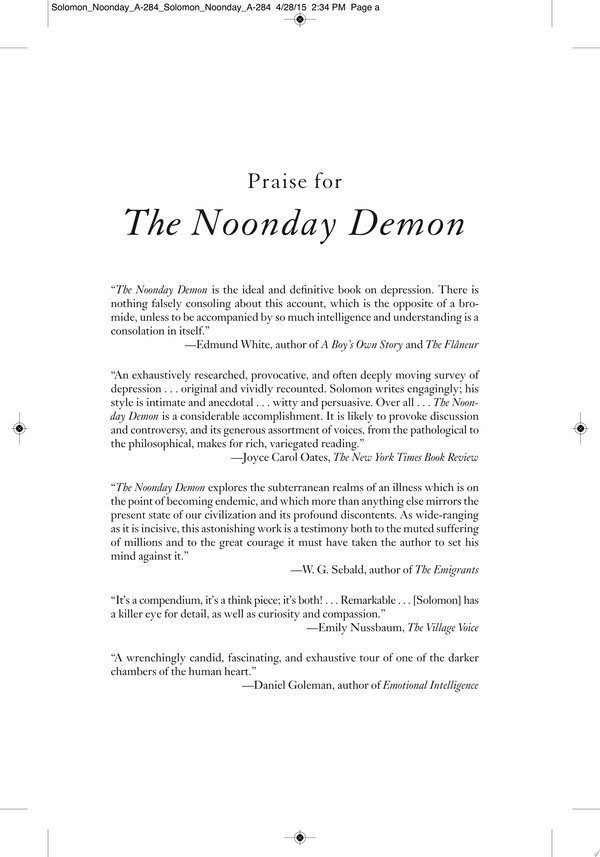
by Andrew Solomon · Scribner
The Noonday Demon is Andrew Solomon’s National Book Award-winning, bestselling, and transformative masterpiece on depression—“the book for a generation, elegantly written, meticulously researched, empathetic, and enlightening” (Time)—now with a major new chapter covering recently introduced and novel treatments, suicide and anti-depressants, pregnancy and depression, and much more. The Noonday Demon examines depression in personal, cultural, and scientific terms. Drawing on his own struggles with the illness and interviews with fellow sufferers, doctors and scientists, policy makers and politicians, drug designers, and philosophers, Andrew Solomon reveals the subtle complexities and sheer agony of the disease as well as the reasons for hope. He confronts the challenge of defining the illness and describes the vast range of available medications and treatments, and the impact the malady has on various demographic populations—around the world and throughout history. He also explores the thorny patch of moral and ethical questions posed by biological explanations for mental illness. With uncommon humanity, candor, wit and erudition, award-winning author Solomon takes readers on a journey of incomparable range and resonance into the most pervasive of family secrets. His contribution to our understanding not only of mental illness but also of the human condition is truly stunning.

by Michael Pollan · Random House
The book that helped make Michael Pollan, the New York Times bestselling author of Cooked and The Omnivore’s Dilemma, one of the most trusted food experts in America In 1637, one Dutchman paid as much for a single tulip bulb as the going price of a town house in Amsterdam. Three and a half centuries later, Amsterdam is once again the mecca for people who care passionately about one particular plant—though this time the obsessions revolves around the intoxicating effects of marijuana rather than the visual beauty of the tulip. How could flowers, of all things, become such objects of desire that they can drive men to financial ruin? In The Botany of Desire, Michael Pollan argues that the answer lies at the heart of the intimately reciprocal relationship between people and plants. In telling the stories of four familiar plant species that are deeply woven into the fabric of our lives, Pollan illustrates how they evolved to satisfy humankinds’s most basic yearnings—and by doing so made themselves indispensable. For, just as we’ve benefited from these plants, the plants, in the grand co-evolutionary scheme that Pollan evokes so brilliantly, have done well by us. The sweetness of apples, for example, induced the early Americans to spread the species, giving the tree a whole new continent in which to blossom. So who is really domesticating whom? Weaving fascinating anecdotes and accessible science into gorgeous prose, Pollan takes us on an absorbing journey that will change the way we think about our place in nature.
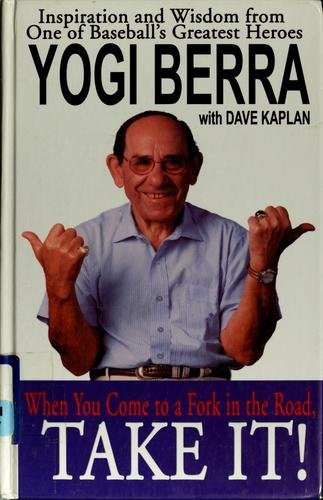
by Yogi Berra with Dave Kaplan · Hyperion
For: Ralph E. Glass.

Historical bestseller data sourced from the New York Times Book Review, archived by Hawes Publications.