1
NEW
LET'S ROLL!
Lisa Beamer with Ken Abraham

LET'S ROLL!
by Lisa Beamer with Ken Abraham · Tyndale
Shares details of the author's marriage and recounts her struggle to cope with the tragedy that cost her the life of her husband.
by Lisa Beamer with Ken Abraham · Tyndale
Shares details of the author's marriage and recounts her struggle to cope with the tragedy that cost her the life of her husband.
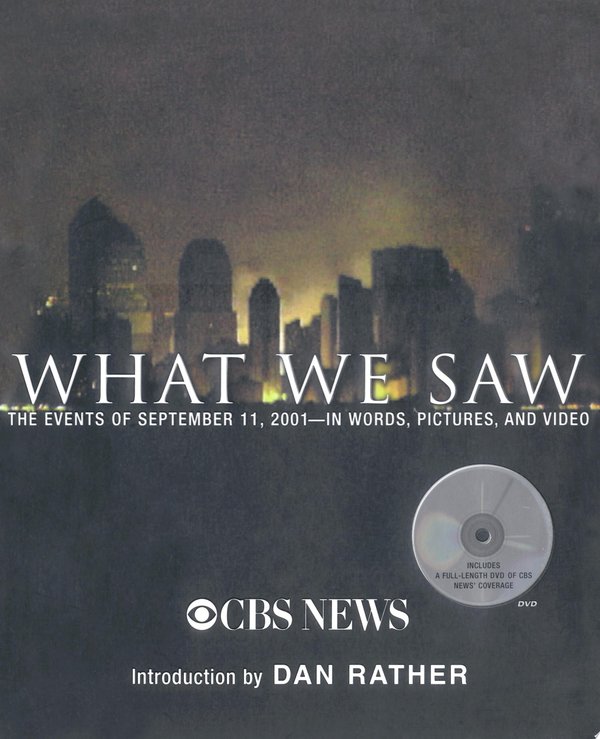
by CBS News · Simon & Schuster
In words, pictures and video, WHAT WE SAW is a unique historical record of the events of September 11th. This unique and moving book records how we learned about this international tragedy and came to understand and survive it. Through still photography, video footage and the accounts of survivors and journalists, the events of that horrific day are brought vividly to life. WHAT WE SAW is a collection of narratives and essays, with black and white photography, and includes a full-length DVD documenting the event and the coverage from the CBS News Archives.
by Mel Levine · Simon & Schuster
"Different minds learn differently," writes Dr. Mel Levine, one of the best-known education experts and pediatricians in America today. And that's a problem for many children, because most schools still cling to a one-size-fits-all education philosophy. As a result, these children struggle because their learning patterns don't fit the schools they are in. In A Mind at a Time, Dr. Levine shows parents and others who care for children how to identify these individual learning patterns. He explains how parents and teachers can encourage a child's strengths and bypass the child's weaknesses. This type of teaching produces satisfaction and achievement instead of frustration and failure. Different brains are differently wired, Dr. Levine explains. There are eight fundamental systems, or components, of learning that draw on a variety of neurodevelopmental capacities. Some students are strong in certain areas and some are strong in others, but no one is equally capable in all eight. Using examples drawn from his own extensive experience, Dr. Levine shows how parents and children can identify their strengths and weaknesses to determine their individual learning styles. For example, some students are creative and write imaginatively but do poorly in history because weak memory skills prevent them from retaining facts. Some students are weak in sequential ordering and can't follow directions. They may test poorly and often don't do well in mathematics. In these cases, Dr. Levine observes, the problem is not a lack of intelligence but a learning style that doesn't fit the assignment. Drawing on his pioneering research and his work with thousands of students, Dr. Levine shows how parents and teachers can develop effective strategies to work through or around these weaknesses. "It's taken for granted in adult society that we cannot all be 'generalists' skilled in every area of learning and mastery. Nevertheless, we apply tremendous pressure to our children to be good at everything. They are expected to shine in math, reading, writing, speaking, spelling, memorization, comprehension, problem solving...and none of us adults can" do all this, observes Dr. Levine. Learning begins in school but it doesn't end there. Frustrating a child's desire to learn will have lifelong repercussions. This frustration can be avoided if we understand that not every child can do equally well in every type of learning. We must begin to pay more attention to individual learning styles, to individual minds, urges Dr. Levine, so that we can maximize children's learning potential. In A Mind at a Time he shows us how.
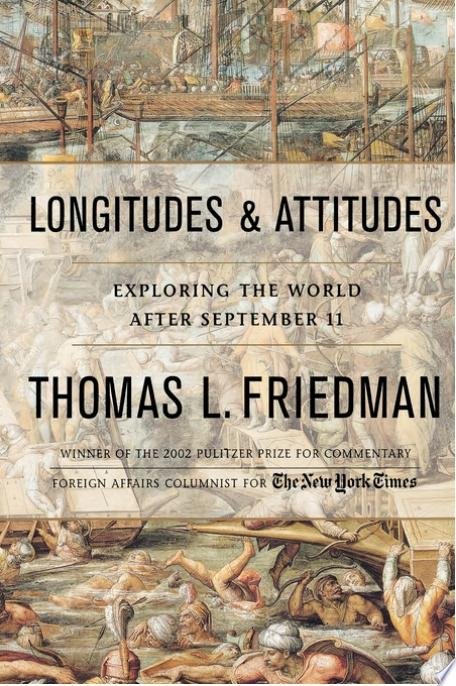
by Thomas L. Friedman · Farrar, Straus & Giroux
America's leading observer of the international scene on the minute-by-minute events of September 11, 2001--before, during and after . As the Foreign Affairs columnist for the The New York Times, Thomas L. Friedman is in a unique position to interpret the world for American readers. Twice a week, Friedman's celebrated commentary provides the most trenchant, pithy,and illuminating perspective in journalism. Longitudes and Attitudes contains the columns Friedman has published about the most momentous news story of our time, as well as a diary of his experiences and reactions during this period of crisis. As the author writes, the book is "not meant to be a comprehensive study of September 11 and all the factors that went into it. Rather, my hope is that it will constitute a 'word album' that captures and preserves the raw, unpolished, emotional and analytical responses that illustrate how I, and others, felt as we tried to grapple with September and its aftermath, as they were unfolding." Readers have repeatedly said that Friedman has expressed the essence of their own feelings, helping them not only by explaining who "they" are, but also by reassuring us about who "we" are. More than any other journalist writing, Friedman gives voice to America's awakening sense of its role in a changed world.

by John Miller and Michael Stone with Chris Mitchell · Hyperion
LSL - Lone Star Library.
by Caroline Myss · Harmony
SACRED CONTRACTS provides the answer to the question world famous intuitive healer Caroline Myss is most frequently asked: 'Why am I here?' 'What is my mission in life?' After 20 years of teaching people how to tap into their innate self-healing powers, Myss feels that the lack of a mission or purpose to life is an emotional illness of epidemic proportions. This can lead to physical illness and emotional distress, including depression, lethargy, anxiety, hopelessness and insecurity, as people take their frustrations out on loved ones, colleagues and children. Myss believes that our personal mission is part of a greater 'sacred contract' that we agree to enter into before we are born. Based on her internationally acclaimed workshop of the same name, SACRED CONTRACTS will help you to uncover your sacred contract to develop better physical and emotional health, and a clear sense of purpose.

by Michael Moore · ReganBooks/ HarperCollins
Rember when everything was looking up? When the government was running at a surplus pollution was disappearing peace was breaking out in the middle East and Northern Ireland and the Bridge to the Twenty-First century was strung with Internet cable and paved with 401 (k) gold? Well, so much for the future. Michael Moore the award winning povocateur behind Roger & Me and the best seller Downsize This! now returns to size up the new century and that big, ugly special interest group that's laying waste to the world as we know it: stupid white men. Among the targets of Mike's Manifesto on Malfeasance and mediocrity are the Bush family Junta, Bll Clinton the Idiot Nation and Corporate American.
by The New York Times · The New York Times/ Callaway
A Challenge of Numbers describes the circumstances and issues centered on people in the mathematical sciences, principally students and teachers at U.S. colleges and universities. A healthy flow of mathematical talent is crucial not only to the future of U.S. mathematics but also as a keystone supporting a technological workforce. Trends in the mathematical sciences' most valuable resourceâ€"its peopleâ€"are presented narratively, graphically, and numerically as an information base for policymakers and for those interested in the people in this not very visible, but critical profession.

by Linda Greenlaw · Hyperion
Greenlaw returns to Isle au Haut--a tiny Maine island with a population of 70 year-round residents, 30 of whom are Greenlaw's relatives.

by Jere Longman · Harper -Collins
The compelling true story of United Airlines Flight 93, the final plane to crash on September 11, and its heroic passengers.
Historical bestseller data sourced from the New York Times Book Review, archived by Hawes Publications.